
Reviewed by Chris Anderson, PsyD, on November 15th, 2026
Table of Contents
- What is a Federal DOT SAP?
- Who Needs a DOT SAP Evaluation?
- How the DOT SAP Process Works
- What Happens During the Initial DOT SAP Evaluation?
- DOT Return-to-Duty Testing
- DOT SAP Follow-Up Testing Requirements
- How Much Does a DOT SAP Program Cost?
What Is a Federal DOT SAP?
The U.S. Department of Transportation (DOT) oversees several transportation industries to protect the public from impaired workers who could pose serious risks to the general public. These include aviation, rail, mass transit, trucking, pipelines, and maritime (U.S. Coast Guard). Federal rules require employers to drug and alcohol test regulated workers in several situations, including pre-employment, random, post-accident, and reasonable-suspicion testing, to ensure workers are fit and not impaired on the job. Any DOT-regulated worker who tests positive for alcohol or drugs must be immediately removed from safety-sensitive duties and is required to get an evaluation from a DOT-qualified Substance Abuse Professional (SAP). The SAP is tasked with protecting the public and ensuring that regulated workers are getting the proper education or treatment to reduce, or ideally eliminate, the risk of future violation or risks of accidents and injuries.
Substance Abuse Professional (SAP)
A Substance Abuse Professional (SAP) is a qualified professional who evaluates individuals who have violated DOT drug or alcohol regulations and then recommends education, treatment, follow-up testing and aftercare. The SAP plays a central role in the DOT return-to-duty process. The SAP conducts an initial clinical assessment, determines what assistance the employee needs, refers the employee to appropriate education or treatment, and evaluates whether the employee has successfully complied with those recommendations. They also establish a follow-up testing plan. This professional does not represent either the employer or the employee; rather, their role is to protect public safety through an independent professional evaluation.
To serve as a DOT-qualified SAP, an individual must meet specific credential, knowledge, training, examination, and continuing-education requirements under 49 CFR Part 40, Subpart O. Eligible professionals can include licensed physicians, licensed or certified social workers or psychologists, employee assistance professionals, state-licensed or certified marriage and family therapists, and appropriately certified drug and alcohol counselors.
Role of the SAP in the Return-to-Duty Process
Substance Abuse Professionals (SAPs) are a key part of the DOT return-to-duty process because they act as an independent safety gatekeeper after an employee violates DOT drug or alcohol regulations. An employee generally cannot return to DOT safety-sensitive work until completing the SAP evaluation and the required education or treatment process.
The SAP evaluates the employee, determines what education or treatment is appropriate, and later conducts a follow-up evaluation to determine whether the employee has successfully complied with those recommendations. SAPs also establish the required follow-up testing plan. Before an employee can resume safety-sensitive duties, the SAP must determine successful compliance, and the employee must then pass the required return-to-duty drug and/or alcohol test. The employer ultimately decides whether to return the employee to the position.
How Do I Find a DOT Qualified SAP Evaluator?
If you have violated a DOT drug or alcohol rule and need a SAP evaluation, you should first check with your employer to see what resources they have available for locating a SAP evaluator. Employees can also check with their DOT agency (FMCSA, FAA, etc.) to see if they have a list of SAP evaluators in the area. Some SAP evaluators are also listed in online directories, such as www.saplist.com. You can also search online, but before you pay for an evaluation or complete any recommendations, confirm that the provider is a DOT-qualified SAP.
Who Needs a DOT SAP Evaluation?
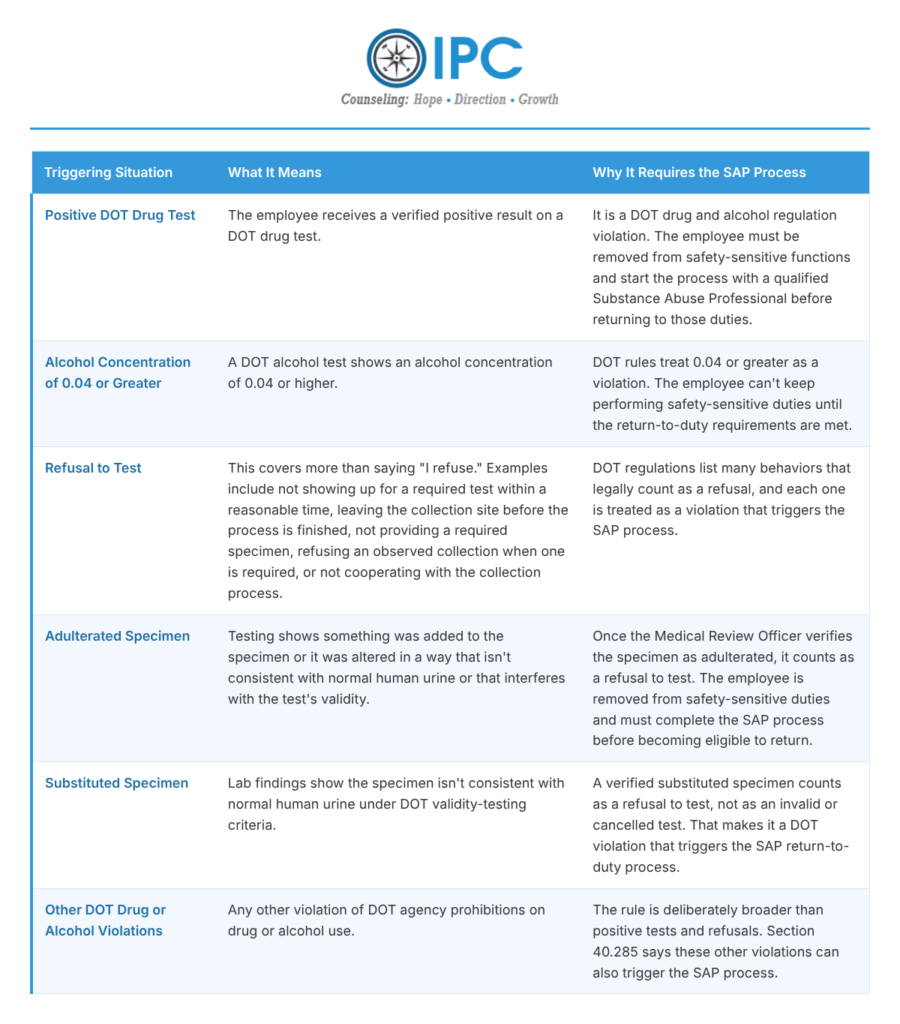
There are several situations under which an individual would be required to undergo a DOT SAP evaluation. Principally, an evaluation is required when a worker covered by DOT drug and alcohol rules commits a violation. Under current regulations, the employee cannot perform DOT safety-sensitive duties again until the return-to-duty process has been completed. It is important to note that this process is tied to DOT-regulated, safety-sensitive work and does not apply to someone who failed a non-DOT workplace drug test. DOT-covered employees can include workers regulated by agencies such as the FMCSA, FAA, FRA, FTA, PHMSA, and U.S. Coast Guard, depending on the job and applicable regulations. The situations that would trigger the need for a DOT SAP evaluation include:
- Positive DOT Drug Test – An employee who receives a verified positive DOT drug test has committed a DOT drug and alcohol regulation violation and must be removed from safety-sensitive functions. Before returning to those duties, the employee must begin the process with a qualified Substance Abuse Professional.
- Alcohol Concentration of 0.04 or Greater – A DOT alcohol test showing an alcohol concentration of 0.04 or higher is also a DOT violation requiring the SAP process. This threshold is important because DOT rules treat an alcohol concentration of 0.04 or greater as a violation that prevents the employee from continuing to perform safety-sensitive duties until the return-to-duty requirements are satisfied.
- Refusal to Test – A refusal is broader than simply saying, “I refuse to take the test.” DOT regulations identify numerous behaviors that can legally be considered a refusal. For a DOT drug test, examples include failing to appear for a required test within a reasonable time, leaving the collection site before the process is completed, failing to provide a required specimen, refusing an observed collection when one is required, or failing to cooperate with the collection process.
- Adulterated Specimens – An adulterated specimen is one in which testing indicates that something has been added or altered in a way that is inconsistent with normal human urine or otherwise interferes with the validity of the test. If the Medical Review Officer verifies the specimen as adulterated, DOT regulations treat that result as a refusal to test. That means the employee is subject to the same basic return-to-duty requirement: removal from DOT safety-sensitive duties and completion of the SAP process before becoming eligible to return.
- Substituted Specimens – This generally means laboratory findings indicate that the specimen is not consistent with normal human urine based on DOT validity-testing criteria. Like an adulterated specimen, a verified substituted specimen is treated as a refusal to test under DOT rules. For this reason, substitution is not simply treated as an invalid or cancelled test. It can become a DOT violation that triggers the SAP return-to-duty process.
- Other DOT Drug or Alcohol Violations – The rule is intentionally broader than positive tests and refusals. Section 40.285 states that other violations of DOT agency prohibitions concerning drug or alcohol use can also trigger the SAP process.
How the DOT SAP Process Works
The federal DOT has some fairly specific and stringent evaluation guidelines that the substance abuse professional (SAP) must adhere to when evaluating an employee. The main purpose of the evaluation is to obtain a very detailed and thorough alcohol and drug history from the employee over their entire lifespan. The SAP is looking for trends and patterns within their use as well as symptoms that are indicative of either substance abuse or dependence. In addition to a drug history, the SAP will be inquiring about a variety of other life circumstances and history. This will include medical history, medication use, legal history, family history, work history as well as mental health history and treatment. All these life areas are assessed in conjunction with the drug history to get a global picture of the employee and their mental, physical, and emotional stability and wellness. In many instances, people of all walks of life turn to chemical use to cope, reduce stress, self-medicate mental health problems, curb loneliness, feel more sociable, or many other reasons, all of which can turn problematic if they are used to manage other life issues.
The SAP will also have the employee take a test that is designed to objectively evaluate substance abuse, possibly verify legal history with local DMV, and verify accuracy of information provided by soliciting input from family and friends of the employee. Once all information is obtained and reviewed, the SAP will make recommendations that will include either some type of education course or possibly treatment. Employees are required to follow through with all recommendations in order to return to their line of work and provide the SAP with proof of completion of all recommendations. Below is a detailed explanation of the process.
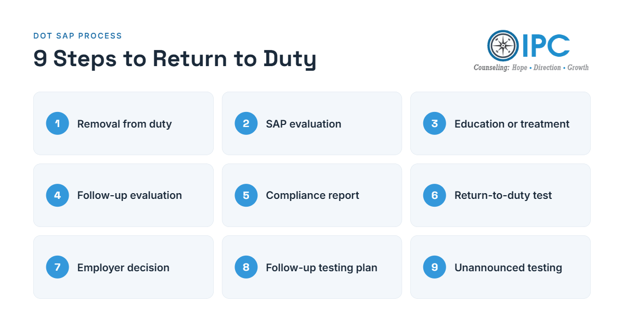
- Removal from Safety-Sensitive Duties – Once the employer learns of the DOT violation, removal from safety-sensitive duties is mandatory and immediate. After a violation, an employee cannot simply test negative the next day and resume duties. A negative result does not by itself erase the DOT violation. The individual is required to go through the required steps before they are permitted to return to work.
- Meeting with a Substance Abuse Professional (SAP) – The first step in the process is for the impacted individual to meet with a SAP. During the evaluation, the SAP may examine factors such as the circumstances surrounding the violation, the employee’s history of alcohol or drug use, previous treatment or education, patterns of use, and other relevant clinical information. The purpose is to determine what intervention is appropriate for that particular employee rather than placing every employee into the same program.
- Education/Treatment Prescribed – After the initial evaluation, the SAP will recommend an appropriate course of education/treatment. Everyone who enters the process must receive a recommendation; the SAP cannot conclude that no education or treatment is needed. The level of assistance can vary considerably. Depending on the circumstances, the SAP’s recommendation could involve a drug or alcohol education course, counseling, a self-help or support program with verifiable participation, outpatient treatment, intensive outpatient treatment, inpatient treatment, or another appropriate intervention.
- Post-Treatment Evaluation – After completing the required education or treatment, the individual must return to the SAP for a follow-up evaluation. At this stage, the SAP reviews information from the education or treatment provider and conducts another clinical interview with the employee. The SAP then decides whether the employee has demonstrated successful compliance with the recommendations. This does not always mean that every form of ongoing treatment or aftercare has completely ended. For example, an employee could potentially be considered successfully compliant for return-to-duty purposes while still being required to continue counseling, aftercare, or another support program.
What Happens During the Initial DOT SAP Evaluation?
The federal DOT has some fairly specific and stringent evaluation guidelines that the substance abuse professional (SAP) must adhere to when evaluating an employee. The main purpose of the evaluation is to obtain a very detailed and thorough alcohol and drug history from the employee over their entire lifespan. The SAP is looking for trends and patterns within their use as well as symptoms that are indicative of either substance abuse or dependence. In addition to a drug history, the SAP will be inquiring about a variety of other life circumstances and history. This will include medical history, medication use, legal history, family history, work history as well as mental health history and treatment. All these life areas are assessed in conjunction with the drug history to get a global picture of the employee and their mental, physical, and emotional stability and wellness. In many instances, people of all walks of life turn to chemical use to cope, reduce stress, self-medicate mental health problems, curb loneliness, feel more sociable, or many other reasons, all of which can turn problematic if they are used to manage other life issues.
The SAP will also have the employee take a test that is designed to objectively evaluate substance abuse, possibly verify legal history with local DMV, and verify accuracy of information provided by soliciting input from family and friends of the employee. Once all information is obtained and reviewed, the SAP will make recommendations that will include either some type of education course or possibly treatment. Employees are required to follow through with all recommendations in order to return to their line of work and provide the SAP with proof of completion of all recommendations.
DOT SAP Education and Treatment Requirements
When a safety-sensitive employee violates a DOT drug and alcohol rule, the Substance Abuse Professional (SAP) evaluation is the first step back to work. The core of that evaluation is the SAP’s recommendation for education, treatment, or both. Under 49 CFR Part 40, Subpart O, the SAP must recommend a course of education and/or treatment that the employee must complete successfully before returning to DOT safety-sensitive duty.
This requirement applies to everyone. The SAP must make a recommendation for every individual who has violated a DOT drug and alcohol regulation. No employee goes straight from evaluation to a return-to-duty test.
Types of Education a SAP May Recommend
Education is usually recommended when the SAP finds that the employee needs to understand substance use risks better but doesn’t show signs of a disorder that calls for clinical treatment. Under the regulation, appropriate education can include bona fide drug and alcohol education courses, self-help groups, and community lectures.
The list isn’t exhaustive, but every education option has to be verifiable. Part 40 specifies self-help groups and community lectures where attendance can be independently verified. Typical examples:
- Drug and alcohol education courses: structured classes, often several hours long, that cover the effects of substance use, how impairment works, and why testing matters in safety-sensitive jobs
- Self-help groups: groups such as Alcoholics Anonymous or Narcotics Anonymous, with attendance documented
- Community lectures: educational sessions on substance use, again with attendance that can be confirmed
Types of Treatment a SAP May Recommend
When the evaluation points to a substance use problem that needs clinical care, the SAP recommends treatment. DOT guidance says treatment can include, but isn’t limited to, in-patient treatment, partial in-patient treatment, outpatient treatment, education programs, and aftercare.
- In-patient treatment: residential care for employees who need the most intensive, round-the-clock support
- Partial in-patient (day treatment): structured programming for much of the day, with the employee living at home
- Outpatient treatment: scheduled individual or group counseling while the employee keeps up daily responsibilities
- Aftercare: ongoing support after the main program ends
SAPs often combine options, for example outpatient counseling plus documented attendance at a self-help group.
How Recommendations Are Determined
Each recommendation must come from an individual clinical assessment, not a standard package. The regulation requires the SAP to assess and clinically evaluate each employee individually and use professional judgment to set an education and/or treatment plan, plus a follow-up testing plan, that fits that employee’s needs. DOT specifically warns SAPs not to give most of their clients the same or substantially similar plans.
The standard behind the recommendation is public safety. The SAP must recommend education or treatment that will, to the greatest extent possible, protect public safety if the employee returns to safety-sensitive work.
DOT also lists factors the SAP must ignore. These include employee claims that the testing process was unjust or inaccurate, attempts to minimize the violation (for example, blaming hemp oil, “medical marijuana,” poppy seeds, or job stress), and the SAP’s own opinions about drug and alcohol testing.
Evaluation format: SAPs can now evaluate employees in person or remotely. The May 2023 Part 40 final rule permanently allows SAPs to conduct evaluations remotely, as long as the technology provides real-time audio and visual interaction between the SAP and the employee. A remote evaluation must still stay within the geographic limits of the SAP’s credential.
Once made, the recommendation is binding. No one, including the employer, the employee, a managed-care provider, or any service agent, may change the SAP’s evaluation or recommendations. Shopping for a more lenient opinion doesn’t work either. An employee who has been evaluated may not seek a second SAP evaluation to get a different recommendation, and if one is obtained anyway, the employer can’t rely on it. The one exception is that the SAP who did the original evaluation may modify the recommendations based on new or additional information, such as input from the education or treatment program.
Requirement to Complete Recommendations Before Moving Forward
Completing the recommended education or treatment is required before the employee can return to work. An employee who has violated DOT rules cannot perform safety-sensitive duties for any employer until they complete the SAP evaluation, referral, and education/treatment process.
After the employee finishes the program, the SAP does a follow-up evaluation. It determines whether the employee actively participated in the education or treatment program and successfully complied with the SAP’s recommendations. If the SAP reports that the employee did not comply, the employer must not return the employee to safety-sensitive duties.
A few other points for employees and employers:
- Skipping the recommendation isn’t allowed. If a SAP sends an employee back for a return-to-duty test without recommending education or treatment, DOT says the employer should send the employee back to the SAP. The SAP then prescribes education and/or treatment and re-evaluates the employee.
- There’s no set timeline. DOT says SAPs should not give employees estimated return-to-duty timelines because each employee’s situation is unique. In a March 2026 notice, DOT also flagged completing the return-to-duty process in a very short timeframe as a problem.
- Employers don’t have to pay for it. Employers are not required to provide a SAP evaluation or any recommended education or treatment for an employee who has violated a DOT drug and alcohol regulation.
- Support can continue after the return to duty. The SAP also gives the employee and employer recommendations for continuing education and/or treatment that apply once the employee is back at work.
The DOT SAP Follow-Up Evaluation
After an employee finishes the education or treatment the Substance Abuse Professional (SAP) recommended, the next step in the DOT return-to-duty process is the follow-up evaluation. Under 49 CFR 40.301, the SAP must re-evaluate the employee to decide whether they have successfully complied with the initial recommendations. The employee can’t take a return-to-duty test or go back to safety-sensitive work until the SAP has made that decision.
Purpose of the Follow-Up Evaluation
The follow-up evaluation shows the employer whether the employee did what the SAP required. It isn’t a second assessment from scratch, and it isn’t a fitness-for-duty exam. It measures one thing: did the employee take part in the recommended program and show that they did the work? The regulation describes it as the SAP’s way to gauge the employee’s compliance for the employer. The SAP’s findings can be one of the reasons an employer decides to return the employee to duty, but the employer makes the final decision about putting the employee back into a safety-sensitive position. The SAP also uses this evaluation to set the follow-up testing plan and to recommend any continuing care the employee needs after returning to work.
Documentation from Treatment or Education Providers
Before deciding on compliance, the SAP must talk with or get documentation from the education or treatment providers the employee was referred to. This gives the SAP an independent record of the employee’s participation instead of relying only on what the employee reports. Documentation often includes attendance records, dates of enrollment and completion, discharge summaries, and the provider’s view of the employee’s engagement and progress. Verified attendance matters most for education recommendations such as self-help groups or community lectures. That’s why Part 40 calls for options where participation can be independently confirmed. The SAP’s final report covers the dates the employee was in the program and a clinical description of how they participated, so this information feeds directly into the report.
Follow-Up Clinical Interview
Besides reviewing provider records, the SAP must conduct a face-to-face clinical interview with the employee. Since the May 2023 Part 40 update, this can happen in person or remotely, as long as the remote session uses real-time two-way audio and video and the SAP stays within the geographic limits of their credential. During the interview, the SAP looks at what the employee learned, how they understand their substance use and the violation, whether they’ve made changes since the initial evaluation, and what support they may still need. The interview gives the SAP direct clinical insight that provider documents alone can’t, and it helps the SAP decide whether ongoing services should continue after the return to duty.
Determining Successful Compliance
The SAP uses the provider documentation and the clinical interview to make a professional judgment about whether the employee has successfully complied. Successful compliance doesn’t always mean the employee finished every part of the recommended plan. DOT allows the SAP to find that an employee has complied even if they still need more help. For example, an employee who finished a prescribed in-patient program may be found compliant even though the SAP wants them to keep going with outpatient counseling or an aftercare program. When the SAP finds the employee compliant, they send a written report directly to the employer’s Designated Employer Representative (DER). The report must be on the SAP’s own letterhead, signed and dated, and it includes the SAP’s clinical determination, a follow-up testing plan, and recommendations for any continuing treatment, aftercare, or support group services. The employee must then pass a return-to-duty test before resuming safety-sensitive work. Any continuing-care recommendations in the report can become a condition of the employee’s return.
What Happens If Requirements Have Not Been Completed?
If the SAP decides the employee hasn’t shown successful compliance, the SAP must send written notice directly to the DER. That report explains the SAP’s clinical reasons for the decision and lists the date of the follow-up evaluation, along with any further evaluations the SAP has scheduled. Once the employer gets this notice, it must not return the employee to safety-sensitive duties. The process doesn’t automatically end there. The SAP may conduct more follow-up evaluations later if the employer decides that’s consistent with the employee’s reported progress and with its own policy or labor-management agreements. This gives the employee a chance to finish the remaining requirements and be re-evaluated. The employer may also act under its own policies, up to and including termination. Either way, the employee stays out of safety-sensitive work for any DOT-regulated employer until a SAP confirms successful compliance and the employee passes a return-to-duty test.
DOT Return-to-Duty Testing
Finishing your SAP recommendations is a big milestone, but it is not the finish line. Before you can perform safety-sensitive work again, DOT requires one more step: a return-to-duty test. Here’s how that test works, what your employer has to do, and why finishing the process doesn’t guarantee you get your job back.
When a Return-to-Duty Test Can Occur
The timing is set by federal rule. If your employer decides to let you return to safety-sensitive work, it must make sure you take a return-to-duty test. Under 49 CFR § 40.305, that test can happen only after your SAP determines that you have successfully completed the education and/or treatment they prescribed.
In practice, the sequence looks like this:
- Complete your initial SAP evaluation.
- Complete every education or treatment recommendation.
- Return to the SAP for a follow-up evaluation.
- SAP sends your employer a report confirming you complied.
- Only then can your employer schedule the return-to-duty test.
At IPC, that follow-up meeting and a verification-of-compliance letter to your employer are both part of our Federal DOT SAP evaluation service. Keep in mind that the SAP’s compliance report doesn’t clear you to return to work on its own. It only allows your employer to move ahead with the return-to-duty test.
Negative Drug Test Requirement
If your violation involved drugs, you need a verified negative drug test before you can return. Return-to-duty drug tests are also collected differently from routine tests. Under 49 CFR § 40.67(b), employers must direct that return-to-duty and follow-up drug tests be collected under direct observation. According to DOT’s direct observation procedures, the observer must be the same gender as the employee, and refusing any part of the observed collection counts as a refusal to test.
A positive result or a refusal sends you back to the beginning, including a new SAP evaluation.
Alcohol Concentration Requirement
If your violation involved alcohol, the return-to-duty test is an alcohol test, and the standard is specific. Section 40.305 requires an alcohol concentration below 0.02 before you can resume safety-sensitive duties. If your violation involved both drugs and alcohol, you need to pass both tests.
Employer Responsibilities
Your employer has its own legal duties in the return-to-duty process:
- No early return. Employers may not return you to safety-sensitive duties until your SAP has confirmed compliance and you’ve passed the return-to-duty test.
- Respect a non-compliance finding. If the SAP reports that you have not complied with their recommendations, your employer must keep you out of safety-sensitive work.
- Order an observed collection. The employer must direct that return-to-duty drug tests be collected under direct observation.
- Report to the Clearinghouse. For drivers regulated by FMCSA, the employer records the return-to-duty test in the Clearinghouse. Once a driver designates Dr. Anderson as their SAP, he can complete the Clearinghouse steps that belong to the SAP.
- Carry out follow-up testing. After you return, your SAP’s plan requires at least six follow-up tests in the first 12 months, and testing can continue for up to 60 months. Employers should schedule these tests without advance notice. The follow-up plan also follows you to future employers and through breaks in service.
Why Completing the SAP Process Does Not Automatically Guarantee Reinstatement
This surprises many people: you can do everything right and still not get your old job back. DOT’s return-to-duty rules set the minimum you must meet before you can return to safety-sensitive work. They do not require your employer to rehire you. Under § 40.305(b), meeting the requirements does not obligate your employer to return you to duty. That remains an employer personnel decision, subject to collective bargaining agreements and other legal requirements.
The SAP doesn’t make that decision either. DOT describes the SAP as a gatekeeper who is not an advocate for either the employer or the employee. The regulation also states that it is the employer who decides whether you go back to a safety-sensitive position.
DOT Follow-Up Testing Requirements
Passing the return-to-duty test gets you back to work, but the return-to-duty process isn’t over yet. Every employee who returns to safety-sensitive duty after a DOT drug or alcohol violation goes into a follow-up testing program. This is a series of unannounced tests your employer administers after you’re back on the job. Knowing how follow-up testing works ahead of time helps you plan for it and avoid surprises.
Purpose of Follow-Up Testing
Follow-up testing does two things. It holds returning employees accountable, and it protects public safety in the months after a violation, when the risk of relapse is highest. Education or treatment gives you the tools to stay sober. Follow-up testing confirms you’re using them while you drive, fly, operate equipment, or do other safety-sensitive work.
Follow-up testing is separate from random testing. You’ll stay in your employer’s random testing pool as usual, and a random test can’t be counted toward your follow-up requirements, even when both happen close together.
Who Creates the Follow-Up Testing Plan
Your Substance Abuse Professional (SAP) creates the follow-up testing plan, not your employer. The SAP writes it at the follow-up evaluation, after confirming you’ve completed the recommended education or treatment. The SAP sends it directly to your employer’s Designated Employer Representative (DER).
The plan reflects what the SAP learned about you during the evaluation and follow-up meeting. That’s why two employees with similar violations can end up with very different plans.
At Innovative Psychological Consultants, the follow-up testing plan is part of Dr. Chris Anderson’s SAP services. It’s included along with the initial assessment, the recommendation letter, the follow-up evaluation, and the compliance verification letter to your employer.
What you won’t receive: You won’t get a copy of the testing schedule. Neither the SAP nor the employer is allowed to tell you how often you’ll be tested or for how long. That keeps each test unannounced.
Drug, Alcohol, or Combined Testing
The SAP decides whether your follow-up tests cover drugs, alcohol, or both, and the plan doesn’t have to match the original violation:
- After a drug violation, the plan may include drug testing only, or alcohol testing too if the evaluation shows a concern with alcohol.
- After an alcohol violation, the plan may include alcohol testing only, or drug testing too.
- The SAP may require both after either type of violation.
Follow-up drug tests are directly observed collections. The timing of follow-up alcohol tests depends on your DOT agency. For FMCSA-regulated drivers, for example, follow-up alcohol tests happen just before, during, or just after you perform safety-sensitive functions.
Test Frequency and Duration
Federal rules set a floor and a ceiling, and the SAP sets the plan within that range:
| Requirement | What the rule says |
| Minimum | At least 6 unannounced tests in your first 12 months back on safety-sensitive duty |
| More in year one | The SAP may require more, such as monthly or twice-monthly testing |
| Maximum length | Testing can continue for up to 60 months (5 years) after you return |
The SAP can modify the plan later, including ending follow-up testing after the first year. The SAP can’t reduce the six-test minimum in the first 12 months.
The plan follows you. Follow-up testing stays with you through breaks in service and job changes. If you go to work for another DOT-regulated employer, that employer learns about the outstanding plan through the required background check and has to complete the remaining tests.
Employer Responsibilities for Administering the Plan
Once the employer has the SAP’s plan, it’s responsible for carrying it out:
- Schedule the tests. The SAP sets how many tests and over what period. The employer picks the actual dates.
- Keep them unannounced. Tests must have no predictable pattern, and you can’t receive advance notice.
- Count only follow-up tests. Random, post-accident, and other tests don’t count toward the follow-up requirement.
- Recollect cancelled tests. A cancelled follow-up test doesn’t count, so the employer has to conduct a new one.
- Follow the plan as written. Employers can’t add DOT follow-up testing beyond what the SAP prescribed.
- Keep you out of safety-sensitive work if the plan isn’t followed. An employee can’t continue safety-sensitive duties unless follow-up testing is being carried out as directed.
For CDL drivers, the employer also reports completion of the follow-up testing plan in the FMCSA Drug & Alcohol Clearinghouse. Until then, the driver’s return-to-duty record isn’t fully closed out.
How Long Does the DOT SAP Process Take?
When a DOT-regulated employee is removed from safety-sensitive duty after a positive test, a refusal, or an adulterated sample, the first question is almost always the same: how soon can I get back to work? The honest answer is that it depends mostly on two things. One is how quickly you complete each step. The other is what the Substance Abuse Professional (SAP) recommends. Motivated employees who need only an education course can sometimes finish the entire return-to-duty process in a few days. Most people take about two to three weeks. Employees who need a full treatment program should plan for several weeks to a few months.
Here’s where the time goes at each stage.
Factors Affecting the Timeline
No two SAP cases are identical, but the same handful of factors Ftest for most of the variation:
- How quickly you schedule the initial evaluation. The return-to-duty clock doesn’t start until you meet with a DOT-qualified SAP.
- How quickly you return your collateral information. Questionnaires from family members or others who can speak to your history are often the slowest part of the evaluation.
- The type and level of the SAP’s recommendation. An education course takes hours. A treatment program takes weeks.
- How quickly you finish the recommendation and schedule your follow-up evaluation.
- How quickly your employer arranges the return-to-duty test, and whether the result comes back negative.
Evaluation Scheduling
Many areas have only a few qualified SAPs, and some can be hard to get in to see. At Innovative Psychological Consultants, Dr. Chris Anderson, Psy.D., LP, SAP, keeps appointment times reserved specifically for SAP evaluations. Most people can be seen within one to three days.
The evaluation itself usually takes about an hour. Dr. Anderson will take a thorough history covering:
- Medical history and medications
- Legal history, family history, and relationships
- Mental health history
- A detailed chemical use history: what you’ve used, how often, and how much at different stages of life
You’ll also complete an objective substance use questionnaire, which typically takes 10 to 20 minutes. After the appointment, the SAP will contact collateral sources, such as a spouse or family member, to verify the information you provided. How fast those contacts respond often determines how fast your evaluation is finalized. You can speed this up by lining up your contacts ahead of time and following up with them.
Learn more about what happens during a federal DOT SAP evaluation →
Follow-Up Evaluation Timing
When you finish the recommended education or treatment, you’ll meet with your SAP again for a follow-up evaluation. This meeting confirms that you completed and complied with every recommendation. You can schedule it as soon as you’re done, so you control much of the timing here.
Once compliance is confirmed, the SAP sends a verification letter to your employer. The SAP also sets a schedule of follow-up tests that you’ll complete after you’re back on the job. For CDL drivers who have designated Dr. Anderson as their SAP, he updates the FMCSA Drug & Alcohol Clearinghouse as you complete each SAP-related step.
Return-to-Duty Testing
After the follow-up evaluation, one step remains before you can return to safety-sensitive work: a return-to-duty drug and/or alcohol test. Your employer arranges the test, and the result must be negative. For CDL holders, your employer is also responsible for recording the result in the Clearinghouse.
Being back on duty doesn’t end your obligations. The follow-up testing schedule the SAP set will be unannounced, and it requires at least six tests in your first 12 months back. It can continue for up to five years.
Why There Is No Single Timeline for Every Case
It would be convenient to promise a set number of days, but the return-to-duty process is built around the individual:
- Every evaluation produces a different recommendation. Two drivers with the same test result can have very different histories and needs.
- Much of the timeline is in the employee’s hands. Booking promptly, returning paperwork quickly, finishing education or treatment, and scheduling the follow-up all move the process forward.
- Some steps depend on other people, such as collateral contacts, education or treatment providers, and your employer’s testing arrangements.
How Much Does a DOT SAP Program Cost?
Probably the largest expense for going through the return-to-duty process and getting a SAP evaluation is the cost of lost wages and earnings. Although some people are able to complete the process within a few days, the average is 2–3 weeks, which can mean lost earnings totaling hundreds or even thousands of dollars. Some employers may even terminate employment, further adding to the burden and expense of testing positive. The actual cost of a DOT SAP evaluation can vary by the provider and the region of the country you live in. In the Midwest, particularly in Minnesota, a SAP evaluation will likely cost between $400 and $500. At Innovative Psychological Consultants, Dr. Chris Anderson, Psy.D., LP, SAP, has a total cost of $400 for a SAP evaluation. IPC also offers a cash discount that brings the cost down to $350 for the whole SAP evaluation.
Federal DOT rules require a specific evaluation with a number of things that must be completed to satisfy their requirements. The evaluation itself is a thorough substance abuse and mental health assessment that is intended to get a complete alcohol and drug history of use. They will also explore various other flags, symptoms, and warning signs in an effort to determine if someone has an abuse or dependence problem. They will explore various life areas in search of problems or stressors that could be causing a person to use substances to cope. These include financial, legal, occupational, relationship, family and medical issues or stressors. Many people struggling with depression or anxiety turn to substances to self-medicate, so mental health concerns will also be explored.
Beyond the basic evaluation, the SAP evaluator will also have you complete a substance abuse test, which is typically a paper and pencil type of exam. They will also be checking with other people who know you to verify information for accuracy. Specifically, they will be inquiring with friends and family to see about reported chemical use and any concerns. The SAP evaluator then has to write up reports and recommendations for the employee, employer, and DOT.
Following completion of any recommendations, the SAP evaluator will conduct a follow-up visit with the employee to discuss the education or treatment experience and then write up a second report for the employee, employer and DOT. Altogether, there is quite a bit of work involved in helping the employee get through the return-to-duty process.